


61 466 986 389


Subclass 189 Invitations Explained: How Occupation Tiers Decide Your Fate (Not Just Points)
December 28, 2025
Australia’s New SkillSelect Invitation Model – Explained Simply
In May 2025, internal Department of Home Affairs documents released under Freedom of Information (FOI) revealed a major structural change in how invitations are issued under the Skilled Independent (Subclass 189) visa program.
This change is not cosmetic. It fundamentally alters who gets invited, how often invitations occur, and why certain occupations are favoured over others .
Let’s break it down in simple terms.
What Is New? (The Big Shift)
1. Invitation numbers are no longer “points-only”
Previously, SkillSelect invitations were largely driven by points ranking. High points often meant faster invitations.
Now:
- Points still matter, but occupation priority matters more
- Invitations are issued based on a Tiered Prioritisation Model
- Some occupations are deliberately throttled, even if candidates have very high points
This explains why many high-point candidates in IT, Accounting, and Engineering have seen little or no movement, while lower-point health professionals receive invitations.
2. Occupation ceilings are back — with multipliers
The Department has quietly reintroduced occupation ceilings, calculated using a new method:
- The number of workers already in Australia (the “stock”)
- Multiplied by a tier-specific percentage
This determines how many invitations each occupation can realistically receive in a program year .
3. Predictable invitation rounds
Instead of irregular, opaque invitation rounds:
Subclass 189 invitations are expected to run quarterly (and sometimes monthly)
Targeted rounds can be run for specific occupations when shortages arise
This is designed to reduce uncertainty and talent loss.
How the Tier System Works (In Plain English)
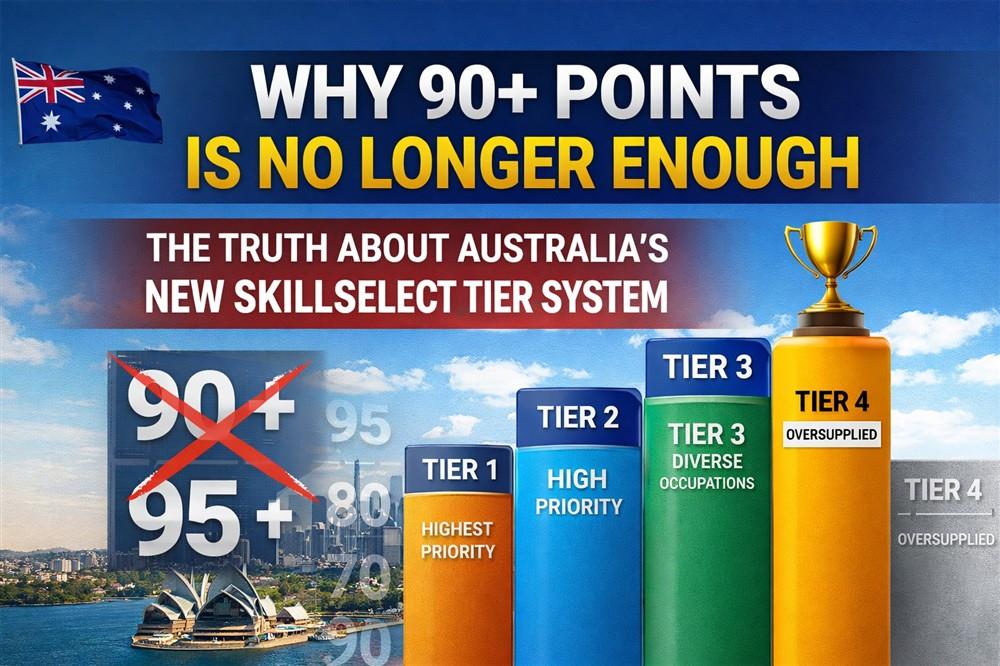
The Department has divided occupations into four tiers, based on:
Skill scarcity
Long-term economic value
Labour market need
Risk of oversupply
Each tier has a different priority level and invitation volume.
Tier 1 – Highest Value Occupations (Top Priority)
- Multiplier: ~4%
- Who gets invited first
These are critical, scarce occupations with high long-term value to Australia, mainly in healthcare.
Examples include:
- Medical Practitioners
- Surgeons
- Psychiatrists
- Anaesthetists
- Cardiologists
- Registered Nurses
- Midwives
- Physiotherapists
- Speech Pathologists
- Diagnostic Radiographers
➡️ Even candidates with lower points in these occupations can receive invitations faster than high-point applicants in other fields.
Tier 2 – High Priority Occupations
- Multiplier: ~2%
- Strong demand, but slightly broader supply
These occupations are still important but not as critically scarce as Tier 1.
Examples include:
- Childcare Centre Managers
- Early Childhood Teachers
- Primary & Secondary School Teachers
- Special Education Teachers
- Psychologists
- Social Workers
➡️ Invitations occur regularly, but not as aggressively as Tier 1.
Tier 3 – Diverse Occupations (Broad Middle Group)
- Multiplier: ~1%
- Balanced selection, diversity focus
This tier exists to maintain economic and occupational diversity.
Examples include:
- Engineers (Civil, Electrical, Mechanical, Structural)
- Architects and Landscape Architects
- Surveyors
- Construction Managers
- Environmental Scientists
- ICT Professionals (some categories)
- Trades such as Electricians, Plumbers, Fitters
- University Lecturers
- Actuaries and Economists
➡️ Points matter more here, and invitations are competitive and slower.
Tier 4 – Oversupplied Occupations (Lowest Priority)
- Multiplier: ~0.5%
- Heavily throttled
These occupations have high supply, and the Department deliberately limits invitations to avoid flooding the labour market.
Examples include:
- Accountants
- Auditors
- ICT Business Analysts
- Systems Analysts
- Software Engineers & Developers
- Multimedia Specialists
- Chefs
➡️ Even 95–100 points does not guarantee an invitation in this tier.
A Simple Example (How This Plays Out)
Candidate A
Occupation: Software Engineer
Points: 95
Tier: Tier 4
Candidate B
Occupation: Registered Nurse
Points: 70
Tier: Tier 1
👉 Candidate B is far more likely to be invited first, despite having significantly fewer points.
This is intentional and policy-driven.
Why the Government Is Doing This
According to the FOI (Freedom of Information) documents:
- 87% of Subclass 189 candidates also apply for state nomination
- There was poor coordination between states and the Commonwealth
- High-value talent was waiting too long and leaving Australia
The new model:
- Targets real shortages
- Aligns 189 with 190, 491, and employer-sponsored visas
- Improves transparency and predictability
What Registered Migration Agents Are Saying
Multiple Australian registered migration agents and migration law firms have publicly analysed this shift on their websites and blogs, noting that:
- Points alone are no longer a reliable strategy
- Occupation strategy now matters more than ever
- Employer sponsorship and state nomination pathways are becoming critical backups
This aligns exactly with what the FOI documents confirm.
Key Takeaway (No Sugar-Coating)
👉 If your occupation is in Tier 3 or Tier 4, waiting passively for a 189 invitation is a high-risk strategy.
👉 If your occupation is Tier 1 or Tier 2, the system is quietly working in your favour.
The SkillSelect system has not become unfair — it has become deliberately selective.
Understanding where you sit in this tier model is now essential, not optional.
Note : This article is based on internal Department of Home Affairs FOI-released documents dated May 2025 and publicly available analysis by Australian registered migration agents .
CATEGORIES
LATEST NEWS